MLOps Explained: How Teams Keep Machine Learning Models Working in Production
A new car runs perfectly when it leaves the showroom. Without regular servicing, tyre checks and oil changes, it slowly gets less reliable, often without any obvious warning. Machine learning models behave the same way. So what is MLOps? It is the servicing schedule for machine learning: the practices and tooling that keep models accurate, reliable, and up to date after launch. Teams that put a proper MLOps setup in place catch problems before customers do.
In short, MLOps (machine learning operations) applies DevOps-style automation and discipline to the full machine learning lifecycle, from data preparation and training to deployment, monitoring and retraining. It exists because ML models depend on data that keeps changing, so a model that was accurate at launch can quietly degrade in production.
The guidance reflects how Acquaint Softtech runs machine learning systems in production as an ISO 27001-certified technology partner, drawing on 1,300+ projects and 70+ in-house engineers serving clients in the USA, UK, Europe, and Australia.
What is MLOps?
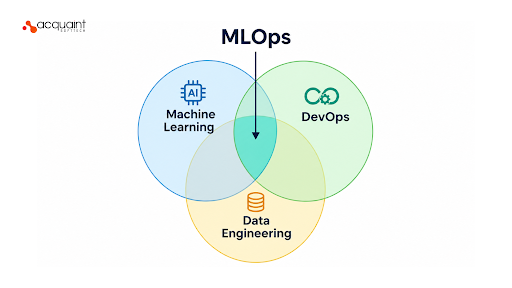
MLOps is a set of practices that makes building, deploying, and maintaining machine learning models repeatable and reliable. It brings together data engineering, data science, and software operations so that models move from experiment to production in a controlled way, and stay healthy once they are there.
In practice, MLOps answers questions that experiments ignore. Which data trained this model? Which version is live? Is it still accurate this week? What happens if it starts making bad predictions? Without clear answers, every model in production becomes a risk.
Why do ML models fail in production?
1. Data drift
The data a model sees in production gradually differs from its training data. A demand forecast trained before a market change, for example, receives inputs it has never seen.
2. Concept drift
The relationship the model learned changes. Fraud patterns evolve and customer behaviour shifts, so yesterday’s signals stop predicting today’s outcomes.
3. Training and serving mismatch
Features calculated one way during training and another way in production produce silently wrong predictions, even though the model itself has not changed.
4. No monitoring
Many teams monitor whether a model’s service is running, but not whether its predictions are still good. Accuracy can fall for months before anyone notices.
5. Manual, unrepeatable releases
When training and deployment depend on one person’s notebook, models are hard to reproduce, roll back or audit, and updates are slow and risky.
The MLOps pipeline, step by step
A mature MLOps pipeline automates the path from data to a monitored model, with checks at each stage.
| Stage | What happens | Why it matters |
| Data validation | Incoming data is checked for quality and changes | Stops bad data reaching the model |
| Training | Models are trained by repeatable, versioned code | Results can be reproduced and audited |
| Evaluation | New models are tested against the current one | Only better models are released |
| Model registry | Approved models are stored with their metadata | Clear record of what is live and why |
| Deployment | Models are released automatically, often in stages | Faster, safer updates and easy rollback |
| Monitoring | Accuracy, drift, latency and cost are tracked | Problems are caught early |
| Retraining | Models are refreshed on new data when needed | Accuracy is maintained over time |
MLOps vs DevOps
MLOps builds on DevOps but adds data and models to the picture. DevOps manages code; MLOps manages code, data, and models together, because any of the three can change how the system behaves.
| Factor | DevOps | MLOps |
| What is versioned | Application code and configuration | Code, data, features and models |
| Testing | Unit, integration, and end-to-end tests | Also data checks and model accuracy tests |
| Failure mode | Bugs and outages | Also silent accuracy loss from drift |
| After release | Monitor uptime and errors | Also monitor predictions and retrain |
The skills overlap heavily. Many MLOps teams pair data scientists with experienced DevOps engineers who already run CI/CD pipelines, infrastructure as code, and monitoring, then extend those practices to models.
MLOps tools by category
Rather than chasing specific products, it helps to think in tool categories. Most MLOps stacks include:
- Experiment tracking: records parameters, metrics and results for every training run.
- Data and feature management: versions datasets and keeps features consistent between training and production.
- Pipeline orchestration: runs data, training and evaluation steps automatically.
- Model registry: stores approved models with their history and approvals.
- Model serving: exposes models through APIs or batch jobs at the right speed and cost.
- Monitoring: tracks drift, accuracy, latency, and spending in production.
Major cloud platforms offer managed versions of most of these, and open-source tools cover each category. The right mix depends on your cloud, team skills and compliance needs.
MLOps for large language models
Applications built on large language models need many of the same disciplines, often called LLMOps. The focus shifts from retraining your own models to managing prompts, retrieval data, evaluation sets, guardrails and cost per request, because outputs can change when a provider updates a model or your documents change.
How to get started
MLOps does not have to start as a large programme. A practical sequence is:
- Version everything. Put training code, data references and model files under version control.
- Automate one pipeline. Make training and deployment for your most important model repeatable.
- Monitor predictions, not just servers. Track accuracy and drift alongside uptime.
- Define retraining triggers. Decide what level of drift or accuracy loss starts a refresh.
- Assign ownership. Name who is responsible for each model in production.
If models are still being designed, build these habits in from the start. Teams working on new machine learning development projects find it far cheaper to plan monitoring and retraining before launch than to retrofit them after the first accuracy problem.
Making the call
Nobody expects a car to run safely for years without servicing, yet many organisations expect exactly that from their machine learning models. MLOps provides the servicing schedule: versioned data and models, automated pipelines, monitoring that watches predictions, and clear rules for retraining. Start with your most valuable model, make it repeatable and observable, and expand from there.
FAQs
What is MLOps?
MLOps (machine learning operations) is a set of practices for building, deploying, monitoring and retraining machine learning models reliably in production.
What is the difference between MLOps and DevOps?
DevOps manages application code; MLOps also manages data and models, adding data checks, accuracy tests, drift monitoring and retraining.
Why do ML models fail in production?
Mainly because of data and concept drift, mismatches between training and production features, missing accuracy monitoring and manual release processes.
Does every company need MLOps?
Any company running ML models that affect customers or decisions needs at least basic MLOps: versioning, monitoring and a retraining plan.